Solar Panels and Roof Snow Load: What to Check
How rooftop solar changes roof snow load: added dead load, drift behavior between rows, and a worked example for snow-country installs.
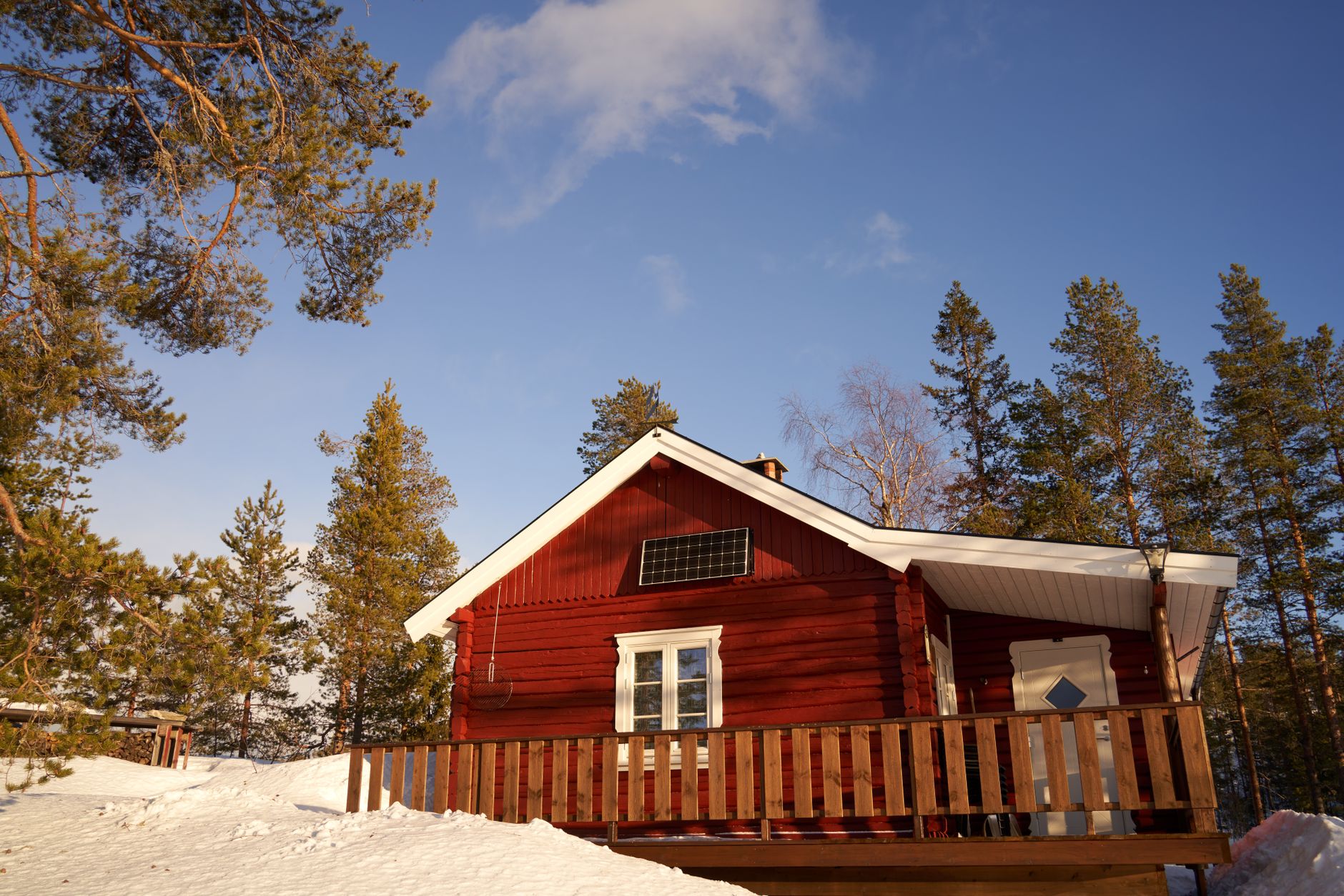
- ›A typical rooftop solar array adds about 3-4 psf of dead load from panels and racking, on top of, not instead of, the roof's snow load.
- ›Smooth panel glass can shed snow faster than the surrounding roof, but racking rails can trap snow at the lower edge and create small drifts between rows.
- ›Before installing, confirm the roof's existing design snow load capacity, then add the array dead load and check that attachment points and rafters still work.
- ›In heavy-snow regions, some designers treat the array footprint conservatively rather than assuming panels shed snow as cleanly as bare roofing.
- ›A worked example below shows a 35 psf design roof adding a 3.5 psf array and staying within a typical rafter's capacity, and where that margin can run out.
Rooftop solar has become routine even in states with serious winter snow, and a fair question follows every install: does the array make the roof's snow problem worse? The honest answer has two parts. Panels and racking add a modest, well-defined dead load that simply stacks on top of whatever snow load the roof already has to carry. But the array also changes how snow behaves on the roof surface itself, shedding faster in some spots and trapping it in others. Neither effect is dramatic on a properly designed system, but both are worth checking before panels go up, especially on an older roof that was not built with much reserve capacity.
Dead load first: what an array actually weighs
A typical residential rooftop solar array, panels plus racking and mounting hardware, adds roughly 3 to 4 psf of dead load spread across its footprint. That number is separate from snow load: dead load is the permanent weight of the installed system itself, present in every load case whether or not snow is on the roof, while snow load is a variable load that comes and goes with the season. In a structural load combination, the two are added together, along with the roof's own weight and any other permanent loads, to get the total the framing has to carry.
Three to four psf sounds small next to a design snow load that might run 30, 50, or 90 psf in a serious snow region, and on a healthy, adequately sized roof it usually is small. The risk is not the array's weight in isolation; it is adding that weight to a roof that was already close to its limit before the panels went up.
How racking changes snow behavior on the roof
Solar panels are smooth, tempered glass, and smooth surfaces shed snow more readily than a granular asphalt shingle, similar in principle to the slippery-surface behavior of a metal roof. That is generally a benefit: an array can clear itself of snow faster than the bare roofing around it once the sun comes out or temperatures rise. But the racking system that holds the panels above the roof surface complicates the picture. The rails and mounting hardware sit a few inches off the roof deck, and snow sliding off the lower edge of one row of panels can pile up against the base of the row below it or against the racking itself, creating small drift-like accumulations between rows rather than a clean, uniform shed.
In heavy-snow regions, some designers respond by treating the array footprint with the same care as a drift-prone area: rather than assuming the whole array behaves like an idealized slippery surface, they check for locally elevated loads where racking interrupts a clean slide path, particularly at the downslope edge of the array.
Worked example: does the roof still work with panels?
Take a roof with an existing balanced design snow load of 35 psf, a reasonable figure for a moderate snow-load region on a well-built residential roof. The array adds 3.5 psf of dead load across its footprint. The combined load the rafters need to carry under that section of roof is 35 psf (snow) plus 3.5 psf (array dead load), or 38.5 psf.
If the original rafters were sized with meaningful reserve capacity, an extra 3.5 psf, about a 10 percent increase, is often well within what the members can take, and many span tables and engineered rafter designs carry that kind of margin as a matter of course. But if the original design was tight, built to the bare code minimum with no extra allowance, or if the roof is older and has already lost some capacity to age, moisture damage, or a prior modification, that same 3.5 psf can be the difference between a roof that passes and one that does not.
The only way to know which situation you are in is to check: confirm the existing design snow load and the rafters' actual capacity, not just their span, before assuming a 10 percent bump is automatically safe. This is exactly the kind of check a structural engineer or the solar installer's engineer of record should run as part of a proper permit package.
A homeowner's checklist before installing solar in a snow-load state
A short list covers most of what matters before signing a solar contract in a snow-load region. Confirm your roof's design snow load, either from the original structural drawings, your local building department, or a calculation for your address and roof type. Ask the installer for the array's dead load per square foot and confirm it is added to, not substituted for, the existing snow load in their structural analysis.
Check the roof's age and condition: older roofs, roofs with visible sagging, and roofs that have already been reroofed once or twice can have less reserve capacity than the original design assumed. Ask specifically how the installer's engineering accounts for snow behavior around the racking, not just the flat dead-load number, especially if you are in a heavy-snow region. Confirm that attachment points are through-bolted into structural framing, not just the roof deck, since snow load transfers through those connections. Finally, get the engineering documentation in writing as part of the permit package; a reputable installer will have this ready, and a jurisdiction in a snow-load area will typically require it before issuing a permit.
Attachment points and rafters: the part people skip
The array's distributed dead load is only half the structural question. Every panel row also transfers load through a set of discrete attachment points, lag bolts or similar fasteners into the rafters or trusses below, and those connections concentrate force at specific spots rather than spreading it evenly like the roof's own uniform snow load does. A rafter that comfortably carries a uniform 38.5 psf across its span can still be overstressed locally if an attachment point lands in the wrong spot, is spaced too far from the next one, or misses solid framing entirely and grabs only sheathing.
This is why solar installers use engineered attachment layouts keyed to actual rafter or truss spacing, not a generic grid, and why an inspector checks attachment locations against the framing plan. Skipping this check does not show up immediately; it shows up as a localized problem, a cracked rafter or a pulled fastener, exactly where the load is heaviest, which in a snow-load state is usually mid-winter.
Does solar always add load, or can it help shed snow?
Solar does add a small, fixed dead load in every case, roughly 3-4 psf, which never goes away regardless of season. On the snow side, the effect is mixed rather than uniformly positive or negative: the smooth panel surface can shed snow faster than bare shingles in some conditions, which is a real benefit, but the racking system can trap snow between rows and at the array's lower edge, which is a real drawback. Neither effect changes the fact that the array's dead load has to be checked against the roof's capacity regardless of how the snow behaves on top of it. Treat the shedding behavior as a secondary consideration and the dead load addition as the primary, non-negotiable check.
Do I need an engineer to add solar in a snow region?
Reputable solar installers in snow-load states typically already include a structural review, often stamped by a licensed engineer, as part of the permit package, because most jurisdictions in serious snow regions require it. If your installer is not offering that documentation, ask directly, and treat a hesitant answer as a red flag rather than a formality to skip. For your own planning before signing a contract, RoofHelm's calculator gives you the ASCE 7-22 design snow load for your address and roof, so you know the baseline number the installer's engineering needs to work against. That planning estimate is not a substitute for the stamped structural analysis a permit requires, but it gives you an informed starting point for the conversation.
| Existing design snow load (psf) | Array dead load (psf) | Combined load (psf) | Increase from array |
|---|---|---|---|
| 20 | 3.5 | 23.5 | 17.5% |
| 35 | 3.5 | 38.5 | 10.0% |
| 50 | 4.0 | 54.0 | 8.0% |
| 70 | 4.0 | 74.0 | 5.7% |
| 90 | 4.0 | 94.0 | 4.4% |
Get your design roof snow load in seconds with the free ASCE 7-22 calculator.
Open the calculatorFrequently asked
01How much dead load does a typical rooftop solar array add?+
Roughly 3 to 4 psf, spread across the array's footprint, accounting for the panels themselves plus the racking and mounting hardware. That figure is added to, not blended into, the roof's existing snow load in the structural load combination.
02Do solar panels reduce snow load because they're slippery?+
Panel glass can shed snow faster than bare shingles, but the racking underneath can trap snow at row edges and create small drifts, so the net effect on snow accumulation is mixed rather than a clean reduction. The dead load addition is the one effect that is certain and has to be checked regardless.
03Can an old roof support solar in a heavy snow area?+
It depends on the roof's original design snow load, its current condition, and how much reserve capacity remains after age and wear. A structural review of the specific roof, not a general rule, is the only reliable way to answer this before installation.
04Does RoofHelm calculate solar-specific loads?+
RoofHelm's calculator gives you the ASCE 7-22 design roof snow load for your address and roof type, the baseline figure a solar installer's structural engineer adds array dead load to. It is a planning tool, not a stamped engineering analysis, which a permit in a snow-load state will still require from the installer.